

Decision Intelligence vs Traditional School ERP: What Schools Need to Know
Digital transformation in schools initially focused on moving administrative activities away from registers, spreadsheets and disconnected manual processes.
This led to the widespread adoption of school ERP and management systems.
These platforms remain valuable for managing areas such as:
- admissions;
- student records;
- attendance;
- fees;
- examinations;
- timetable;
- teachers and staff;
- communication.
But as schools become more data-driven, leadership teams increasingly need something beyond record management.
They need to understand:
Why is something happening?
Which information deserves attention?
What patterns are developing?
What should we do next?
This is where Decision Intelligence differs from a traditional school ERP.
What Does a Traditional School ERP Do?
ERP systems primarily help schools record and manage operational activities.
For example, an attendance module may show:
Class 8A attendance this month: 89%.
That is useful information.
However, school leaders may still need to investigate:
- Is 89% unusual?
- When did attendance begin declining?
- Which students are primarily affected?
- Are specific days contributing to the pattern?
- Has academic performance changed at the same time?
- Does intervention need to happen?
A traditional report provides data.
The interpretation often remains entirely with the user.
What Is Decision Intelligence?
Decision Intelligence focuses on helping people move beyond raw information toward understanding and action.
The progression becomes: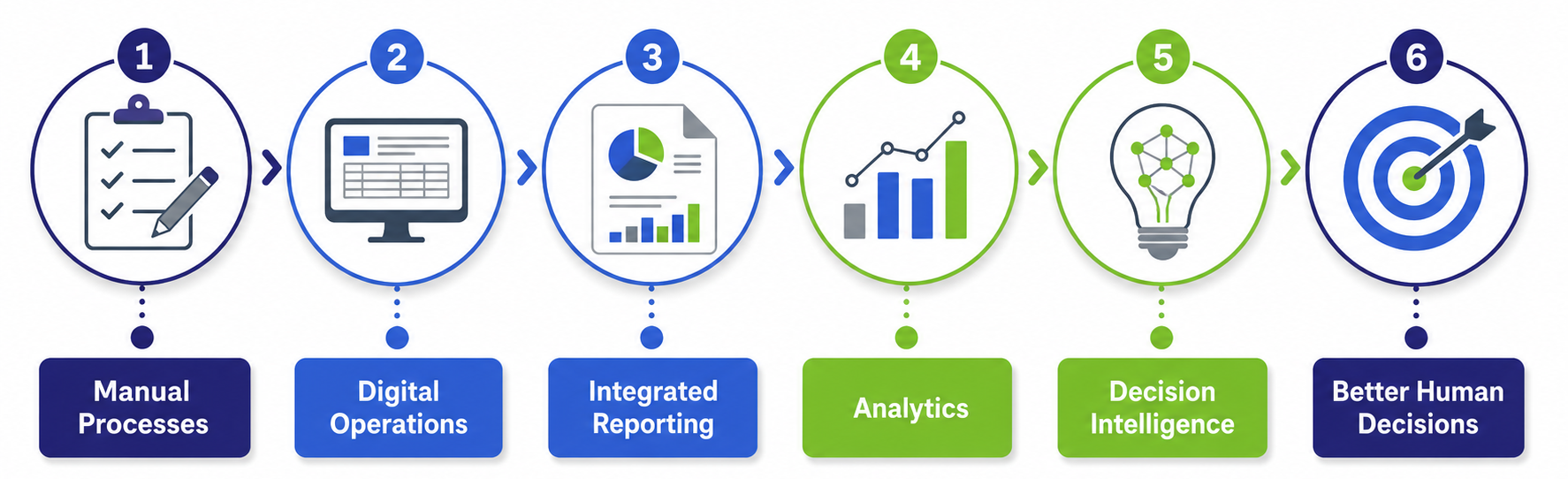
Instead of displaying isolated indicators, Decision Intelligence can help users recognise meaningful relationships and priorities across school information.
For example:
Attendance for a particular student group has declined consistently for six weeks while assessment performance has also weakened.
The system is no longer merely storing information.
It is helping decision-makers identify something that may deserve investigation.
Learn more about Decision Intelligence for Schools.
ERP Usually Answers “What?”
Traditional systems commonly answer questions such as:
- What is today's attendance?
- How many fees remain unpaid?
- What are the examination results?
- Which teachers are absent?
- What classes are scheduled today?
These are essential operational questions.
Decision Intelligence Helps Answer “So What?”
Decision Intelligence goes further:
- Which attendance changes deserve attention?
- Which academic trends may require intervention?
- Where are students repeatedly struggling?
- Which operational patterns appear unusual?
- What information should management review first?
The objective is to reduce the amount of manual interpretation required before leaders can identify areas requiring action.
ERP and Decision Intelligence Can Work Together
Schools do not necessarily need to choose between an operational system and Decision Intelligence.
The two serve different purposes.
ERP manages processes and generates operational information.
Decision Intelligence helps people understand what that information may mean.
A modern school ecosystem can therefore connect:
Operations → Reports → Analytics → Decision Intelligence
SproutSong's Pulse environment is designed around this broader connected approach rather than treating school technology as a collection of disconnected modules.
Reporting Is Not the Same as Decision Intelligence
Reporting remains essential.
Schools require:
- student report cards;
- attendance reports;
- examination reports;
- fee reports;
- assessment summaries;
- management reports.
Reporting tells users what the information contains.
Decision Intelligence goes further by helping identify which patterns may require attention.
That makes Academic Reporting Software for Schools an important foundation for better academic decisions.
Human Judgement Remains Essential
Decision Intelligence should not mean allowing software to make important educational decisions automatically.
Education involves people and circumstances that data alone cannot fully explain.
Technology may identify a pattern.
A teacher, principal, counsellor or administrator still needs to understand the context.
A responsible model therefore remains:
Technology identifies → Human investigates → Professional decides → School acts
Questions Schools Should Ask Technology Providers
Instead of asking only:
Which modules does your software provide?
schools should increasingly ask:
- How does the platform connect information?
- Can management identify important trends?
- Can academic and operational data work together?
- Can access differ according to each user's role?
- Can reporting lead to actionable insight?
- How does the system support human decision-making?
- Can the technology evolve as the school grows?
These questions shift the conversation from software features toward institutional outcomes.
From Digitisation to Intelligence
The first stage of school digital transformation was digitising records and administrative processes.
The next stage is making those systems more connected, useful and intelligent.
The evolution can be understood as:
Schools do not need technology simply to generate more data.
They need technology that helps the right people understand the right information at the right time.
Explore SproutSong
Discover Decision Intelligence for Schools and explore how SproutSong is building a connected school ecosystem around operations, reporting, analytics and intelligent decision support.